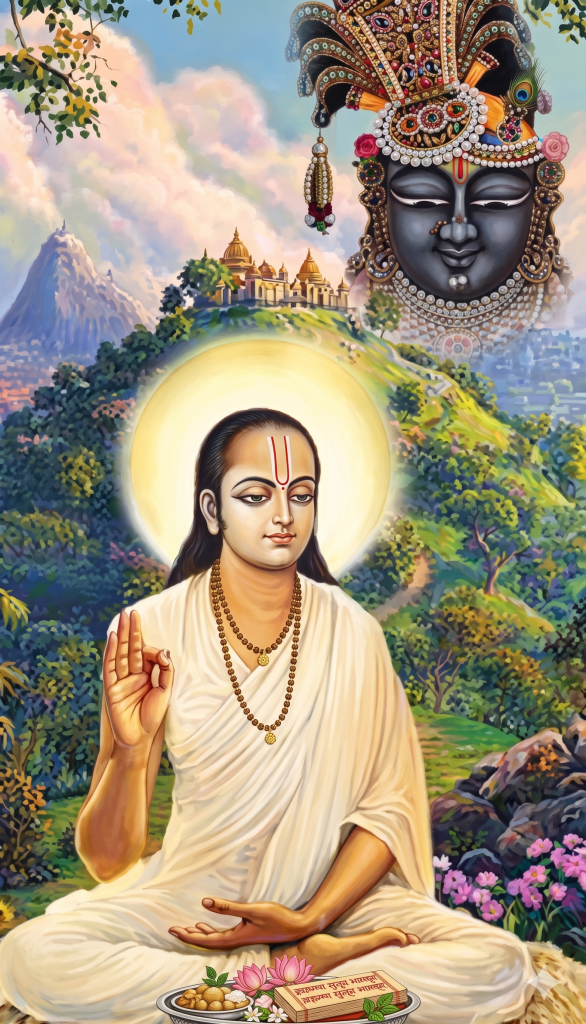
Shree Vallabhacharya, lovingly known as Mahaprabhuji, stands among the greatest spiritual luminaries of India’s Bhakti era. Born in 1479 CE, he was not only a philosopher of extraordinary depth but also a divine teacher who transformed the understanding of devotion. As the founder of Pushtimarg—the Path of Divine Grace—he revealed a way of life centered on प्रेम (divine love), सेवा (selfless service), and पूर्ण समर्पण (total surrender) to Shree Krishna, especially in the form of Shrinathji.
Miraculous Birth and Early Signs of Divinity
Shree Vallabhacharya was born in Champaran (modern-day Chhattisgarh) during a time of political unrest. His parents, Lakshmana Bhatta and Illamma, were devoted scholars of the Vedic tradition. According to sacred accounts, his birth itself was miraculous—he was believed to have been born prematurely during a dangerous journey and was left under a tree wrapped in cloth, only to be later found alive and radiant, symbolizing divine protection.
From infancy, Vallabhacharya displayed signs of extraordinary spiritual awareness. By the age of seven, he had mastered the Vedas, Upanishads, Puranas, and various philosophical systems. His brilliance was not merely intellectual—it was deeply spiritual, reflecting a soul already awakened to divine truth.
Education and Spiritual Awakening
As he grew, Vallabhacharya engaged with the greatest scholars of his time. He traveled to renowned centers of learning such as Varanasi, where he participated in debates on Vedanta philosophy. His interpretations challenged prevailing views, particularly those of illusion (Maya) as proposed by Advaita Vedanta.
He established his doctrine of Shuddhadvaita Brahmavada—Pure Non-dualism—teaching that the world is not an illusion but a real and divine manifestation of God. According to him, everything in existence is a form of Brahman (the Supreme), and the soul’s purpose is to lovingly reconnect with the Divine through grace.
The Three Great Pilgrimages (Digvijaya Yatras)
A defining aspect of Vallabhacharya’s life was his extensive spiritual journeys across India, known as Digvijaya Yatras. He is believed to have completed three major pilgrimages, covering sacred regions from the Himalayas to South India.
During these journeys, he:
- Spread the message of devotion and grace
- Engaged in philosophical debates with scholars
- Initiated followers into the path of Pushtimarg
- Established sacred seats known as Bethaks (84 in total), marking places where he delivered discourses
These 84 Bethaks remain important pilgrimage sites for devotees even today.
Divine Encounter with Shrinathji
One of the most significant moments in Vallabhacharya’s life was his divine connection with Shrinathji, a form of Lord Krishna manifesting as the lifter of Govardhan Hill. This sacred form is associated with Govardhan Hill.
It is believed that Vallabhacharya recognized Shrinathji as the supreme deity for the age and established the foundation for His seva (loving service). This relationship became the heart of Pushtimarg, where God is not worshipped from a distance but served intimately as a beloved child, friend, or master.
Later, the worship of Shrinathji flourished in Nathdwara, which became the spiritual center of this tradition.
Establishment of Pushtimarg – The Path of Grace
Vallabhacharya’s teachings crystallized into the Pushtimarg tradition, which offers a unique approach to spirituality:
- Grace over effort: Liberation is attained through God’s grace (pushti), not merely through personal effort
- Seva (loving service): Devotees serve the deity as a living presence—offering food, clothing, music, and care
- Householder spirituality: Unlike paths that demand renunciation, Pushtimarg encourages living a family life while remaining spiritually connected
- Intimate devotion: God is treated as a प्रियजन (beloved), fostering a deeply personal bond
The Ashtayam Seva (eight daily darshans) structure of worship reflects the daily life of Krishna, making devotion continuous and emotionally rich.
Literary and Philosophical Contributions
Shree Vallabhacharya was a prolific writer whose works remain foundational:
- Anubhashya – Commentary on the Brahma Sutras
- Subodhini – Commentary on the Bhagavata Purana
- Siddhanta Rahasya – Essence of his philosophical teachings
- Tattvartha Deep Nibandha – Explanation of metaphysical truths
His writings articulate the concept that divine bliss (Ananda) is the true nature of existence, and that devotion infused with love is the highest path.
Family Life and Successors
Unlike many spiritual leaders, Vallabhacharya embraced family life. He married Mahalakshmi and had two sons, including Vitthalnath (also known as Gusainji), who played a crucial role in expanding and organizing the Pushtimarg tradition.
Through his lineage, the practices of seva, temple traditions, and philosophical teachings were preserved and spread across generations.
Final Years and Divine Departure
In his later years, Vallabhacharya gradually withdrew from worldly activities. In Varanasi, he is believed to have entered a state of divine absorption.
According to tradition, he performed Asur Vyamoha Leela—a sacred departure—where he walked into the waters of the Ganges while chanting the name of the Lord, merging into the Divine in 1531 CE.
Enduring Legacy
The legacy of Shree Vallabhacharya continues to flourish through:
- The global Pushtimarg community
- Temples dedicated to Shrinathji and Krishna
- The continuation of the 84 Bethak pilgrimage tradition
- Daily seva practices followed by thousands of devotees
His teachings have deeply shaped devotional culture, especially in regions like Rajasthan and Gujarat, and continue to inspire seekers worldwide.
Conclusion
Shree Vallabhacharya’s life is a profound testament to the power of divine love and grace. He redefined spirituality by bringing God closer to the heart of human life—not as a distant entity, but as a living, loving presence.
His path teaches that through sincerity, seva, and surrender, every soul can experience the bliss of divine connection. In a world often driven by effort and struggle, Vallabhacharya’s message remains timeless: that the highest truth is प्रेम—pure, unconditional love for the Divine.